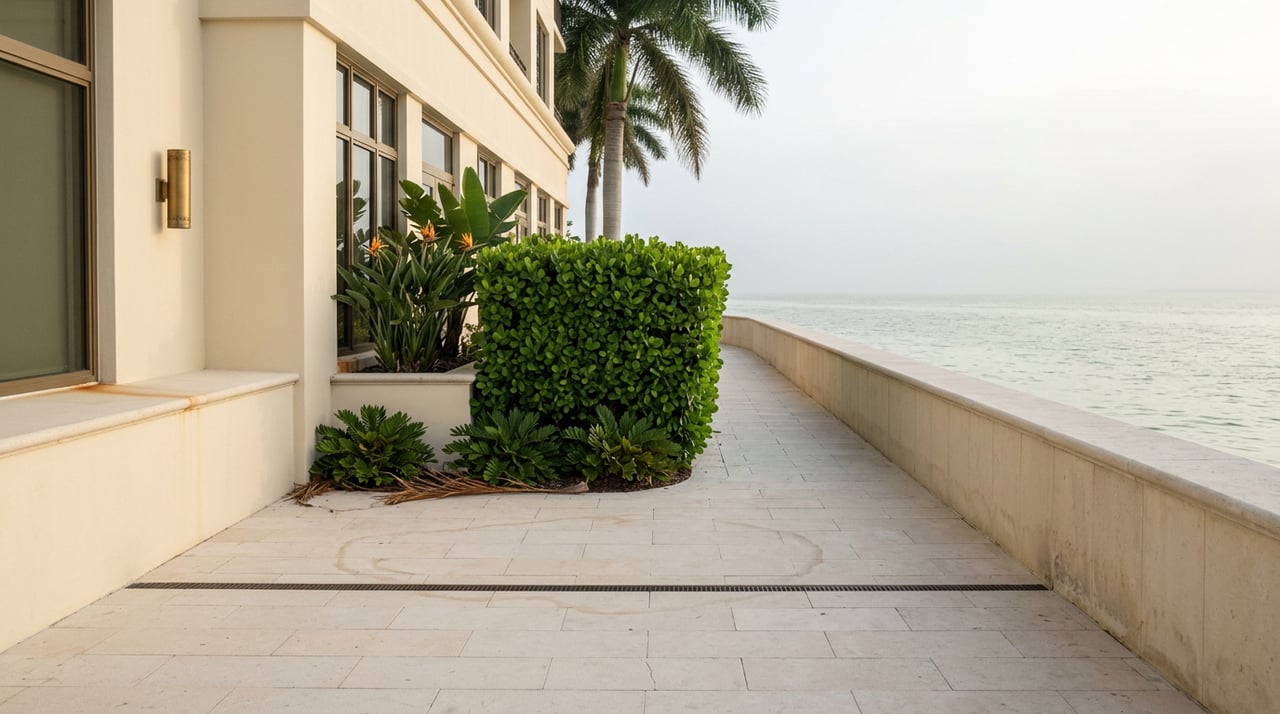
Cross onto the Brickell Key Bridge on a weekend morning this year and you'll still find runners turning around at the same spot they've been turning around since last summer: a barrier a few yards past the bridge deck, with signage that reads more like an apology than a warning. The loop that used to take 30 to 45 minutes at a moderate pace now ends early for most people who aren't island residents. This isn't a memory from a few years back. It's happening now, in 2026, on a project residents were told would be wrapped up by the start of this year.
When the City of Miami began rehabilitating the 52-year-old Brickell Key Bridge in July 2025, the timeline given to residents was specific. Coverage at the time from Miami Today put the finish date at December 2025 or early 2026, and Islander News separately reported the work would run into early 2026. The city's own project page tells a different story now: superstructure work is listed as ending in April 2026, with substructure work running through June 2026. That's not a rounding error. It's roughly half a year past what people living on the island were told to expect, and it helps explain why the loop still isn't fully back even as summer winds down.
What the City Said, and What Actually Happened
| Timeline claim | Source | Date reported |
|---|---|---|
| Bridge work to finish "December 2025 or early 2026" | Miami Today | July 2025 |
| Bridge work to run "until early 2026" | Islander News | August 2025 |
| Baywalk closure "for the foreseeable future," residents-only access | Miami New Times | August 2025 |
| Superstructure completion | City of Miami project page | Listed as April 2026 |
| Substructure completion | City of Miami project page | Listed as June 2026 |
| City still arranging bridge funding via property sale | Miami Today | July 22, 2026 |
| Loop reported "still closed" by users | AllTrails trail reviews | April and June 2026 |
The slip matters less as a scheduling curiosity and more as a pattern. As of July 22, 2026, a month after the substructure work was supposed to wrap, Miami commissioners were still being asked to approve selling a historic 1905 building at 190 SE 12 Terrace, once the office and surgical practice of Dr. James M. Jackson, Miami's first resident physician, to a buyer affiliated with Citadel. The proceeds were earmarked specifically for Brickell Key Bridge repairs. A completion date on a city project page and a fully funded, fully closed-out project are two different things, and Brickell Key is currently living in the gap between them.
The Sentence That Matters More Than the Construction Schedule
Part of why the loop hasn't snapped back on schedule has nothing to do with concrete or rebar. In an email to residents that circulated in a Brickell Facebook group last year, the Brickell Key Master Association described the residents-only access policy this way:
"This is a temporary measure designed to reduce congestion and ensure that our community remains a safe and enjoyable place for everyone."
That's policy language, not construction language. A construction closure ends when the work is inspected and signed off. A congestion management measure ends whenever the association that wrote it decides it should end, and there's no requirement that the two calendars line up. If you're planning your year around "the bridge will be done, so the loop will be open," you're assuming BKMA's access decision and the city's construction schedule are the same decision. Nothing in the public record says they are.
This isn't the only spot on the loop where access depends on someone's discretion rather than a construction crew's timeline. Neal Schafers, head of urban planning at the Miami Downtown Development Authority, has noted that the marina gates at the Four Ambassadors building, right at the foot of the Brickell Key bridge, get shut from time to time on their own, cutting off Baywalk access whether or not any construction is underway. Brickell Key's loop has always had at least one chokepoint that runs on private schedule, not public one. This year just made that more visible.
What Already Came Back, On Its Own Timeline
While the walking path stalled, the neighborhood's dining scene didn't wait for anyone's permit. Three additions landed on their own market calendar, not the city's:
- The Mexican opened April 9, 2026, at 601 Brickell Key Drive, on the island itself. Owned by Monterrey-born entrepreneur Roberto González Alcalá, the 10,000-square-foot restaurant seats roughly 330 guests across indoor dining rooms, a waterfront bar, and a lower terrace facing Biscayne Bay. It's the first sit-down anchor to open directly on the island since La Mar closed, meaning islanders finally have somewhere to eat dinner without crossing the bridge again.
- Seia, a contemporary Italian restaurant and private members' club, opened atop 830 Brickell in March 2026, curated by the Bastion Collection in partnership with OKO Group, with Alessandro Morrone running the kitchen.
- PopUp Bagels is confirmed for 801 Brickell, joining the brand's existing South Florida locations in Aventura, Delray Beach, and West Palm Beach. As of July 2026, no opening date has been set.
None of that required a bridge inspection or a coordination agreement between a city and a developer. Restaurants open when leases and buildouts are ready. Bridges and access policies reopen when the parties involved agree they should, and on Brickell Key this year, those have been two very different clocks.
Where You Can Actually Walk Today
If you live here now and want to know what's usable without waiting on either timeline, the southern tip of the island still works. Brickell Key Park opens at 6 a.m., making it one of the earliest-accessible waterfront spots in downtown Miami, and the promenade there has stayed open through most of the disruption. The full 1.5-mile perimeter loop, maintained by the City of Miami and mapped on AllTrails, is the piece that's been inconsistent, with reviewers reporting it closed as late as April and June of this year. There's no food or beverage vendor inside the park itself, so if you're planning a longer walk, bring water and expect to check current access before you go rather than assume it matches what the bridge project page says.
The larger point for anyone living on or near Brickell Key is that this year didn't just interrupt a walk. It separated two things that used to move together: the physical rebuild of the island's access points, and the social rebuild of what people do when they get there. The restaurants filled in fast because that market doesn't need a construction permit from the city or a policy decision from an HOA board. The loop is taking longer, and even when the fencing comes down, the thing to watch isn't the city's project page. It's whatever BKMA decides "safe and enjoyable" means once the work is actually finished.
If you're weighing how any of this affects a specific building on Brickell Key, whether you're already living there or watching the market from across the bridge, the Thormann Caltabiano Group tracks these building-by-building shifts across Miami-Dade's waterfront corridor as part of how we advise buyers and sellers here. Schedule a consultation if you want to talk through what the island's slow rebuild means for the property you're in or the one you're considering.